WIN THE ULTIMATE GIANT STOCKING GAME BUNDLE!
18+ Games • $350+ Value • Ends Dec 31st
The Strategic Value of Modern Tabletop Gaming Assets: An Economic Analysis
The global entertainment sector has witnessed a paradigm shift over the last decade, with analog gaming—specifically the modern board and party game market—demonstrating a Compound Annual Growth Rate (CAGR) that outpaces many digital sectors. For the astute investor or consumer, understanding the micro-economics of tabletop gaming offers more than just leisure; it presents a unique study in value retention, social capital accumulation, and cost-per-entertainment-hour efficiency. While digital assets fluctuate wildly based on server availability and licensing agreements, physical game assets represent tangible, transferable wealth in the entertainment economy.
In this technical analysis, we will explore the financial underpinnings of building a robust gaming portfolio. We will examine the utility of these assets in networking scenarios, the supply chain factors influencing their valuation, and the comparative ROI against other leisure activities. Furthermore, we will discuss how acquiring a diversified “basket” of these assets—such as the massive bundle offered by Cheer Up Games—can serve as a hedge against inflation in the leisure spending sector. This is not merely about “playing games”; it is about optimizing the allocation of discretionary income for maximum social and personal yield.
1. Portfolio Diversification through Tangible Entertainment Assets
When analyzing household expenditure, the “Entertainment” line item is often the most volatile. By capitalizing on physical assets like Good Soup, Jungo, or Anomia Pop Culture, a household effectively front-loads their entertainment costs. Unlike subscription services (SaaS) which drain capital monthly regardless of usage, a board game purchase is a one-time capital expenditure (CapEx) that yields dividends in perpetuity. The initial outlay creates an asset that can be utilized repeatedly without marginal cost increases.
Furthermore, the secondary market for out-of-print or high-demand games has shown resilience similar to collectibles like vinyl records or vintage video games. A comprehensive bundle serves as an immediate diversification of this asset class. Games like Fib + Expansion or Rabble utilize different cognitive mechanisms—bluffing versus word association—thereby ensuring the “portfolio” remains relevant across different social demographics and gathering types. Owning a diverse range of mechanics ensures that the asset holder can cater to any market condition (i.e., any group of guests), maximizing the utility rate of the collection.
From a liquidity standpoint, physical games maintain a floor value. Unlike digital downloads which cannot be resold, a physical copy of Cheese Factory or Bot or Not retains a percentage of its MSRP on secondary markets like eBay or GeekMarket. In some cases, specifically with “Kickstarter Exclusive” versions or limited print runs, the asset can appreciate, offering a positive ROI upon exit. This makes the acquisition of a large bundle not just a purchase, but a strategic hold.
2. The Micro-Economics of Social Capital and Networking
In the professional world, “Social Capital” refers to the networks of relationships among people who live and work in a particular society, enabling that society to function effectively. Board games are high-efficiency engines for generating social capital. A game like Sync or Vibe + Chill acts as a low-stakes interface for high-stakes relationship building. The “Rule Circle” creates a temporary, structured environment where hierarchy is flattened, allowing for genuine interaction between individuals of varying professional statures.
Facilitating a game night is a leadership activity. The host (asset holder) controls the environment, the resources (snacks/drinks), and the tools (the games). This positions the host as a central node in the social network, increasing their influence. The “Giant Red Stocking” full of games is essentially a toolkit for community building. Games like Drink If… or Birdy Call accelerate the “forming, storming, norming, performing” stages of group dynamics, bypassing hours of unstructured small talk.
Moreover, the cognitive overhead of modern networking is high. Traditional mixers are inefficient. Structured play, however, provides a focal point. It allows for the demonstration of soft skills: negotiation (Rabble), risk assessment (Toots and Poops), and rapid adaptability (Widgets). Observers can assess the emotional intelligence and strategic thinking of peers in a simulated environment, providing valuable data for future professional collaborations.
3. Manufacturing Trends and Supply Chain Impacts on Valuation
The cost basis of tabletop gaming is heavily tied to global logistics and raw material futures, specifically paper pulp, cardstock, and injection-molded plastics. Recent inflationary pressures on shipping containers and manufacturing in East Asia have driven the MSRP of games upward. We are seeing a trend where the “price per pound” of entertainment is rising. Therefore, acquiring a bulk reserve of games *now*—particularly through zero-cost entry vectors like sweepstakes—is a hedge against future price hikes.
Titles included in high-value bundles often represent a mix of manufacturing complexities. Obelisk and Boblin’s Rebellion likely involve complex components that are sensitive to supply chain disruptions. By securing these assets immediately, the consumer bypasses the risk of “out of stock” notifications or reprint delays that plague the industry during Q4 (Holiday Season). The “Giant Red Stocking” is not just a festive container; it represents a warehouse of pre-inflationary value.
Additionally, the environmental impact of manufacturing is leading to a shift toward sustainable materials, which often come at a premium. As the industry pivots, legacy versions of games or those produced during this transitionary period may hold unique value for collectors interested in the production history of the medium. The sheer volume of this specific bundle (18+ titles) suggests a significant raw material value that exceeds the sum of its parts when factoring in individual shipping and handling costs for separate purchases.
4. Long-Term ROI: Calculating Value Per Entertainment Hour
To strictly quantify the value of the Cheer Up Games bundle, one must apply the Value Per Entertainment Hour (VPEH) metric. A standard cinema experience currently averages $20 for 2 hours ($10/hr). A Triple-A video game is $70 for roughly 40 hours ($1.75/hr). Board games, however, offer an asymptotic approach to zero cost per hour over time. A game like Swearmints (Green or Red) can be played infinitely. If a game costs $25 and is played for 50 hours over its lifetime, the cost is $0.50/hr.
If you win a bundle worth over $350 containing 18+ games, your cost basis is zero. This results in an infinite ROI (Return on Investment). Even if you only factor in the *opportunity cost* of the time spent entering the giveaway (approx. 30 seconds), the yield is astronomical compared to any traditional financial instrument. The bundle includes diverse titles like Good Soup and Anomia Pop Culture, ensuring that the “replayability” factor remains high, preventing the asset from becoming “dead inventory” on your shelf.
Furthermore, these assets are transferable. They can be gifted (offsetting future spending obligations for birthdays or holidays), donated for tax deductions, or traded. The liquidity of a sealed or well-maintained game is surprisingly high in niche markets. Therefore, participating in this specific asset acquisition event is a rational economic decision for any household looking to maximize their entertainment budget efficiency.
The Tactical Entry Point: Zero-Cost Acquisition
While the market analysis suggests a strong “buy” rating for tabletop assets, the optimal acquisition strategy is always to minimize the entry cost. This brings us to the Cheer Up Games “Stocking Stuffer Giveaway.” By leveraging the promotional budget of the sponsor, you have the opportunity to acquire the entire diversified portfolio discussed above—Good Soup, Jungo, Anomia, and 15 other titles—without utilizing personal capital. This is the definition of infinite leverage.
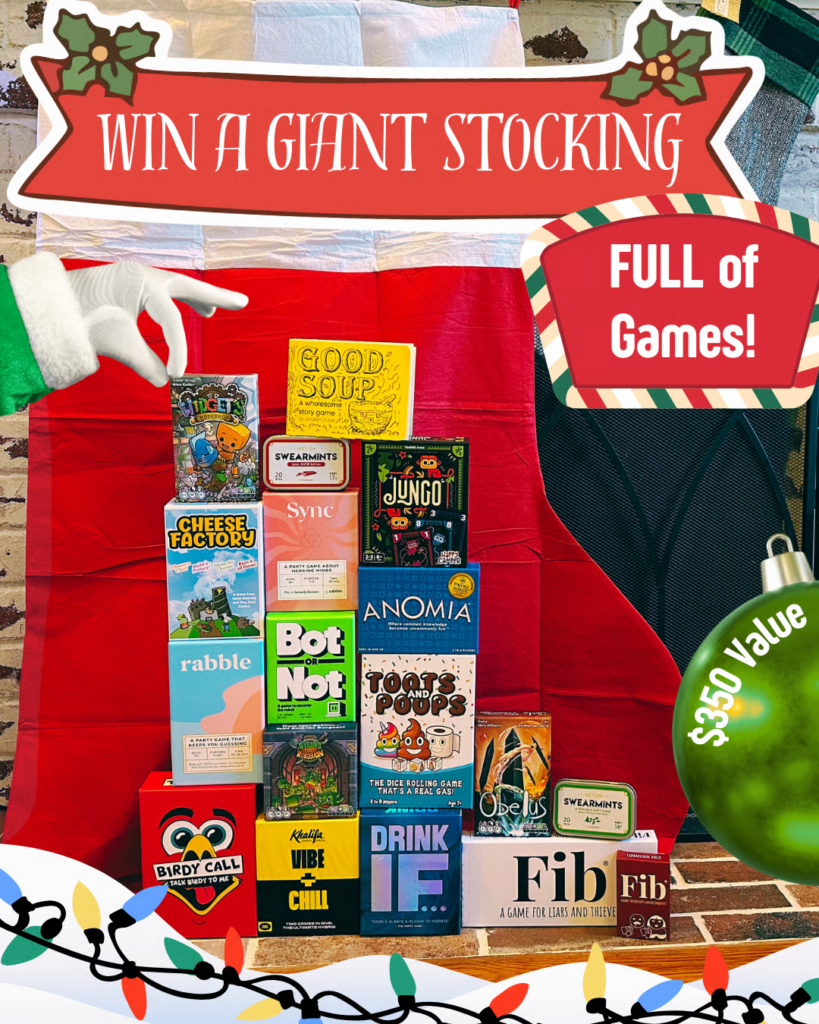
Win the Ultimate Stocking Stuffer Game Bundle ($350+ Value)
Sponsor: Cheer Up Games
• Good Soup, Jungo, Anomia Pop Culture
• Fib + Expansion, Cheese Factory, Rabble
• Bot or Not, Sync, Toots and Poops
• Widgets, Obelisk, Boblin’s Rebellion
• Drink If…, Vibe + Chill, Birdy Call
• Swearmints (Green & Red)
• One (1) Giant Red Stocking
ENTER TO WIN