$167.5 Million Non-Bank ATM Settlement: See If You Qualify
- Prize
- Settlement payment; individual amount not yet determined
- Ends
- February 10, 2027
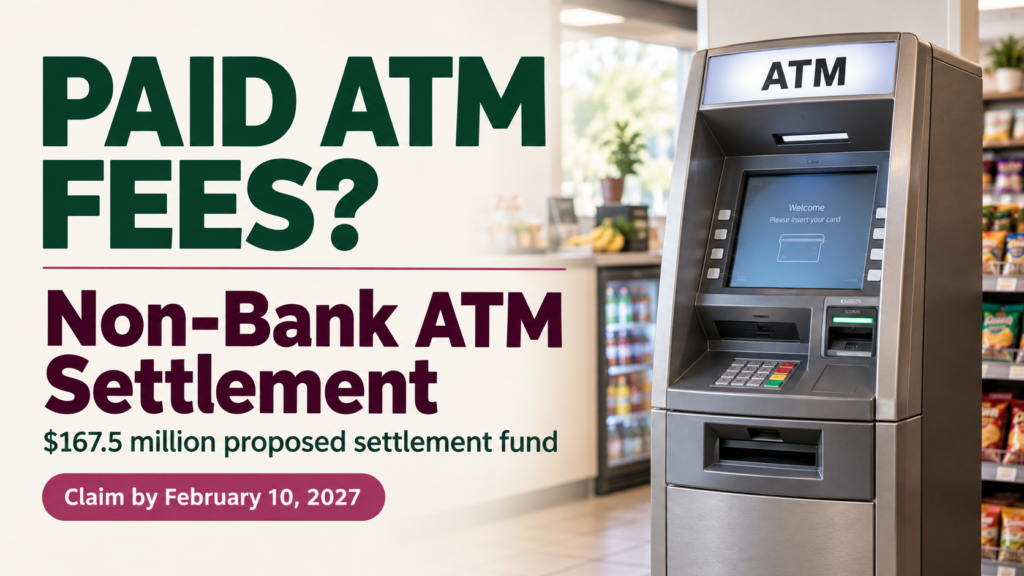
Paid a fee to take cash out of a non-bank ATM? This settlement is worth a look. A proposed $167.5 million Non-Bank ATM Surcharge Settlement could provide payments to eligible people who paid qualifying ATM access fees between October 24, 2007, and August 14, 2026.
The claim deadline is February 10, 2027. You do not have to upload documents when you file, but you must qualify and provide truthful information. The administrator can request supporting records later.
Non-Bank ATM Settlement at a Glance
- What it covers
- Qualifying access fees paid at independently owned, non-bank ATMs.
- Who may qualify
- Eligible U.S. ATM users whose qualifying surcharges were not fully reimbursed.
- Covered transactions
- October 24, 2007–August 14, 2026
- Potential payment
- Amount not yet known. Eligible claims share the net settlement fund.
- Proof requirements
- No documents required initially; proof may be requested later.
- Claim deadline
- February 10, 2027
The $167.5 million is the total proposed fund—not a per-person payment. Court approval and valid claims are required.
Who Qualifies for the Non-Bank ATM Surcharge Settlement?
According to the official settlement website, the nationwide class generally covers people who:
- Withdrew money from a deposit account using an ATM or PIN-debit card at an independent ATM in the United States or its territories.
- Paid an ATM surcharge between October 24, 2007, and August 14, 2026.
- Did not receive full reimbursement of that surcharge from their bank.
An independent ATM is not owned by Visa, Mastercard, a bank, or another financial institution. Using another bank’s ATM does not automatically qualify. Credit-card withdrawals, cash advances, and prepaid-card transactions are excluded. Additional statewide classes cover qualifying transactions in California, Illinois, Massachusetts, and Michigan. Review the official notice for the complete class definition and exclusions.
Do You Need Proof to File an ATM Settlement Claim?
No documentation is required at the time of filing. However, the official claim instructions allow the administrator to ask for bank statements or other supporting information later. This is not an unrestricted “no-proof” payout.
The form asks for an estimate of your qualifying transactions. Use your honest recollection and any records available to you; do not inflate the count. You certify your answers under penalty of perjury.
How Much Money Could You Receive?
There is no confirmed dollar amount per person. Payments will be proportional to qualifying transactions, and depend on the approved claims. The total fund also covers approved legal fees, administration expenses, taxes, and service awards before payments to eligible claimants. See the administrator’s payment FAQ.
Important Settlement Dates
- December 11, 2026
- Exclusion requests must be received; objections must be postmarked. Follow the notice’s specific instructions.
- February 10, 2027
- Claim submission deadline.
- February 17, 2027, at 4 p.m. ET
- Scheduled fairness hearing—not the claim deadline. Check the official site for changes.
When Will Payments Be Sent?
There is no guaranteed payment date. Distribution depends on final approval and resolution of any appeals. The administrator will provide payment instructions, with digital options and an option to request a paper check. Keep your email and phone information up to date.
Is This the Same as the Earlier ATM Settlement?
No. This case, Burke v. Visa Inc., No. 1:11-cv-01882, concerns independent, non-bank ATMs. The notice distinguishes it from a separate case involving bank-operated ATMs. A previous ATM settlement claim does not replace reviewing this one’s requirements.
Read the Official Notice Before You Decide
The lawsuit alleges that Visa and Mastercard’s network rules caused inflated independent-ATM access fees. Both companies deny wrongdoing. Remaining in the class affects your legal rights; doing nothing generally means no payment while still releasing the covered claims.
Read the Official Settlement Notice
Questions about your situation? Contact the settlement administrator. This article is general information, not legal advice.
Checked September 15, 2026 against the official settlement website, notice, FAQs, and claim form. Only submit a claim if you qualify.
Keep going