💎 The Ultimate Guide to Lab-Created Diamonds: Quality, Value & Sustainability in 2026
Discover why lab-created diamonds have revolutionized the jewelry industry, offering identical quality to mined diamonds at a fraction of the cost. Learn about the science behind lab-grown gems, how to evaluate quality, and why they represent the future of sustainable luxury jewelry.
Understanding Lab-Created Diamonds: Science and Technology
Lab-created diamonds represent one of the most remarkable achievements in materials science, replicating in weeks what nature takes billions of years to accomplish deep within the Earth’s mantle. These diamonds are not simulants or imitations—they are genuine diamonds with identical chemical composition, crystal structure, and optical properties to mined diamonds. The only difference lies in their origin: one forms naturally under extreme geological conditions, while the other grows in a controlled laboratory environment using advanced technology that recreates those same conditions.
Two primary methods produce lab-created diamonds: High Pressure High Temperature (HPHT) and Chemical Vapor Deposition (CVD). HPHT technology mimics the natural diamond formation process by subjecting carbon to pressures exceeding 1.5 million pounds per square inch and temperatures around 2,700 degrees Fahrenheit. CVD technology takes a different approach, using a carbon-rich gas in a vacuum chamber where carbon atoms deposit onto a diamond seed crystal, building the diamond layer by layer. Both methods produce diamonds that are chemically, physically, and optically identical to mined diamonds, indistinguishable without specialized equipment.
The quality of lab-created diamonds has improved dramatically over the past decade, with modern production techniques yielding gems that rival or exceed the quality of most mined diamonds. Early lab-grown diamonds often contained metallic inclusions or color tints that made them less desirable for jewelry applications. Today’s advanced manufacturing processes produce colorless, internally flawless diamonds that meet the highest standards of the jewelry industry. Many lab-created diamonds achieve grades of D-F color and VVS-IF clarity, representing the pinnacle of diamond quality that would command premium prices in mined stones.
Evaluating Lab-Created Diamond Quality
Lab-created diamonds are graded using the same standards applied to mined diamonds: the Four Cs of Cut, Color, Clarity, and Carat weight. Independent gemological laboratories including the Gemological Institute of America (GIA), International Gemological Institute (IGI), and American Gem Society (AGS) certify lab-grown diamonds with the same rigor they apply to natural stones. These certifications provide detailed analysis of a diamond’s characteristics, giving buyers confidence in their purchase and establishing objective quality standards.
Cut quality remains the most important factor in a diamond’s beauty, regardless of origin. A well-cut diamond maximizes brilliance, fire, and scintillation by precisely controlling how light enters, reflects, and exits the stone. Lab-created diamonds can be cut to ideal proportions more economically than mined diamonds because the lower rough material cost justifies the additional labor required for optimal cutting. This means consumers can often find lab-grown diamonds with superior cut grades at price points where mined diamonds would typically feature compromised cuts to preserve carat weight.
Color and clarity in lab-created diamonds span the full range found in mined diamonds, from colorless to fancy colored, and from flawless to included. However, the controlled production environment allows manufacturers to produce higher concentrations of top-quality stones. While only about 2% of mined diamonds achieve colorless D-F grades, a much larger percentage of lab-created diamonds reach these premium color grades. Similarly, the absence of geological accidents during formation means lab-grown diamonds can achieve higher clarity grades more consistently than their mined counterparts.
💎 Lab vs. Mined: Quality Comparison
Independent testing confirms that lab-created diamonds are physically, chemically, and optically identical to mined diamonds. Both score 10 on the Mohs hardness scale, both have the same refractive index of 2.42, and both exhibit identical thermal conductivity. Even professional gemologists cannot distinguish lab-created from mined diamonds without specialized equipment that detects subtle growth patterns or trace elements specific to each formation method.
Price Comparison and Value Proposition
The most compelling advantage of lab-created diamonds lies in their exceptional value proposition, typically costing 40-70% less than comparable mined diamonds. This dramatic price difference reflects the elimination of mining costs, reduced supply chain complexity, and more efficient production processes. For consumers, this means either purchasing a significantly larger or higher-quality diamond for the same budget, or achieving their desired specifications at a fraction of the cost they would pay for a mined stone.
The price gap between lab-created and mined diamonds has widened over time as production technology has improved and scaled. Early lab-grown diamonds commanded prices only 20-30% below mined equivalents, but increased production efficiency and growing competition among manufacturers have driven prices lower while quality has simultaneously improved. This trend benefits consumers but also raises questions about long-term value retention, as lab-created diamonds may not appreciate like rare mined stones historically have.
Understanding the value proposition requires considering your priorities and intended use. For engagement rings and fine jewelry meant to be worn and enjoyed rather than held as investments, lab-created diamonds offer extraordinary value. The money saved can be allocated toward better cut quality, larger carat weight, superior color and clarity, or more elaborate settings. For those viewing diamonds primarily as financial assets or heirlooms, mined diamonds may retain value better over decades, though this consideration matters less for jewelry purchased primarily for personal enjoyment.
Environmental and Ethical Considerations
Lab-created diamonds appeal strongly to environmentally and socially conscious consumers who want to avoid the environmental impact and ethical concerns associated with diamond mining. Traditional diamond mining requires moving massive amounts of earth, consuming enormous quantities of water and energy, and permanently altering landscapes. Large-scale mining operations can displace communities, damage ecosystems, and create long-term environmental liabilities that persist long after mines close. Lab-grown diamonds eliminate these concerns by producing gems in controlled facilities with minimal land use and no habitat destruction.
The energy consumption of lab-created diamond production deserves nuanced consideration. Growing diamonds requires significant electricity to generate the extreme temperatures and pressures necessary for crystallization. However, the total environmental footprint remains substantially lower than mining when accounting for all factors including land disruption, water usage, waste generation, and transportation. Additionally, many lab-grown diamond producers are transitioning to renewable energy sources, further reducing their carbon footprint and enhancing their sustainability credentials.
Ethical sourcing represents another compelling advantage of lab-created diamonds. Despite industry efforts like the Kimberley Process, concerns persist about conflict diamonds, exploitative labor practices, and human rights abuses in some diamond-producing regions. Lab-grown diamonds offer complete supply chain transparency and eliminate any possibility of inadvertently purchasing stones associated with violence, exploitation, or environmental destruction. For consumers who prioritize ethical consumption, this peace of mind represents value beyond the monetary savings.
🌍 Sustainability Impact
Research comparing the environmental impact of mined versus lab-created diamonds shows that lab-grown stones generate significantly less carbon emissions per carat, use a fraction of the water, and create no mining waste or habitat destruction. While exact figures vary by production method and energy source, studies consistently show that lab-created diamonds have a substantially smaller environmental footprint across all major impact categories.
Popular Styles and Settings for Lab-Created Diamonds
Lab-created diamonds work beautifully in all jewelry styles, from classic solitaire engagement rings to elaborate statement pieces featuring multiple stones. The cost savings enable more ambitious designs that might be prohibitively expensive with mined diamonds. Halo settings, pavé bands, three-stone rings, and vintage-inspired designs all benefit from the ability to use larger center stones or more accent diamonds without exceeding budget constraints. Designers increasingly embrace lab-grown diamonds as they allow creative freedom without the financial constraints imposed by mined stone prices.
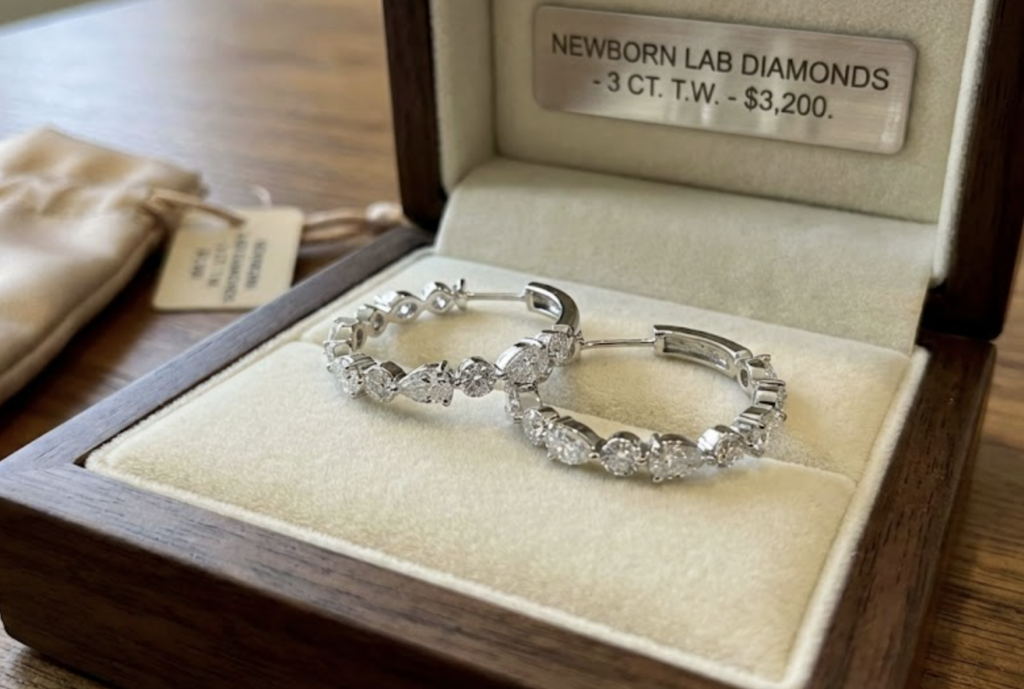
Hoop earrings represent one of the most popular applications for lab-created diamonds, combining timeless elegance with versatile wearability. Inside-out hoop designs, where diamonds line both the interior and exterior of the hoop, create maximum sparkle from every angle. The substantial carat weights required for impressive hoop earrings make lab-created diamonds particularly appealing—a pair of three-carat total weight diamond hoops in mined stones might cost $15,000-25,000, while lab-created equivalents deliver identical beauty for $3,000-5,000.
Modern consumers increasingly mix lab-created and mined diamonds in their jewelry collections, selecting each based on the specific piece and intended use. Anniversary bands, fashion rings, earrings, and pendants often feature lab-grown stones where the priority is maximizing visual impact within budget. Heirloom pieces or engagement rings might incorporate mined diamonds for their traditional appeal and potential long-term value retention. This flexible approach allows consumers to enjoy more jewelry overall while allocating resources according to personal priorities.
Care and Maintenance of Lab-Created Diamond Jewelry
Lab-created diamonds require identical care to mined diamonds because they are chemically and structurally the same material. Regular cleaning maintains brilliance and fire, as everyday oils, lotions, and dirt can accumulate on diamond surfaces and dull their appearance. A simple solution of warm water and mild dish soap, combined with gentle brushing using a soft toothbrush, effectively removes most buildup. Professional cleaning and inspection every six months ensures settings remain secure and stones stay properly positioned.
Despite their exceptional hardness, diamonds can chip or crack if struck with sufficient force at vulnerable angles. Removing diamond jewelry during activities that risk impact—sports, heavy lifting, gardening—protects both the stones and their settings. Storing diamond pieces separately or in individual compartments prevents diamonds from scratching other jewelry or each other. These precautions apply equally to lab-created and mined diamonds, as their physical properties are identical.
Insurance considerations for lab-created diamond jewelry differ slightly from mined stones due to their lower replacement cost. While mined diamond jewelry might be insured for its purchase price or appraised value, lab-created pieces should be insured for their actual replacement cost, which may be significantly lower. Working with insurers who understand lab-grown diamonds ensures appropriate coverage without overpaying premiums. Maintaining certificates, receipts, and professional appraisals facilitates the insurance process and provides documentation for replacement if necessary.
The Future of Lab-Created Diamonds
The lab-created diamond industry continues evolving rapidly, with technological advances improving quality, reducing costs, and expanding production capacity. Analysts project that lab-grown diamonds will capture an increasingly large share of the diamond jewelry market, particularly among younger consumers who prioritize value, sustainability, and ethical sourcing. Major jewelry retailers have embraced lab-created diamonds, with many now offering extensive collections alongside traditional mined stones, legitimizing lab-grown gems in the mainstream market.
Innovation in colored lab-created diamonds represents an exciting frontier, as controlled production environments enable creation of fancy colored diamonds in hues rarely found in nature. Blue, pink, yellow, and even red lab-grown diamonds can be produced more consistently and affordably than their extremely rare natural counterparts. This democratization of colored diamonds opens new design possibilities and makes previously unattainable colors accessible to broader audiences. Fashion-forward consumers increasingly seek these unique colored stones for distinctive jewelry that stands apart from traditional colorless diamonds.
The relationship between lab-created and mined diamonds will likely evolve toward market segmentation rather than direct competition. Mined diamonds may increasingly position themselves as luxury goods valued for their natural origin and rarity, similar to how natural pearls command premiums over cultured pearls despite being physically identical. Lab-created diamonds will continue gaining market share based on value, sustainability, and ethical appeal. Both categories can coexist, serving different consumer preferences and use cases within the broader jewelry market.
💎 You Made It! Enter the Sweepstakes Below
💎 ENTER HERE 💎💍 Prize Details
- Grand Prize:
- 3ct. t.w. Round and Pear Cut Lab Created Diamond Hoop Earrings
- 14K White Gold
- Inside-Out Design
- Value: $3,200
- Number of Winners:
- One (1) lucky winner
- Prize Claim:
- Must visit Kesslers location within 30 days
📋 Quick Facts
- Entry Period:
- Jan 1 – March 31, 2026
- Entry Limit:
- One entry per person
- Entry Method:
- Online at kesslersdiamonds.com
- Eligibility:
- U.S. Residents, 18+
- Winner Selection:
- Random drawing on April 9, 2026
- Winner Notification:
- Via phone/email within 2 days
- Requirements:
- IRS W9 form and affidavit required
💎 You made it! Enter now for your chance to win $3,200 diamond hoop earrings!